

Year-Round Angling: Why Underwater Lights Aren’t Just for Summer
Locating active fish beneath a frozen lake often requires drilling dozens of holes and spending hours searching structure. To streamline this process, experienced ice anglers rely on underwater lighting to draw fish directly to their location.
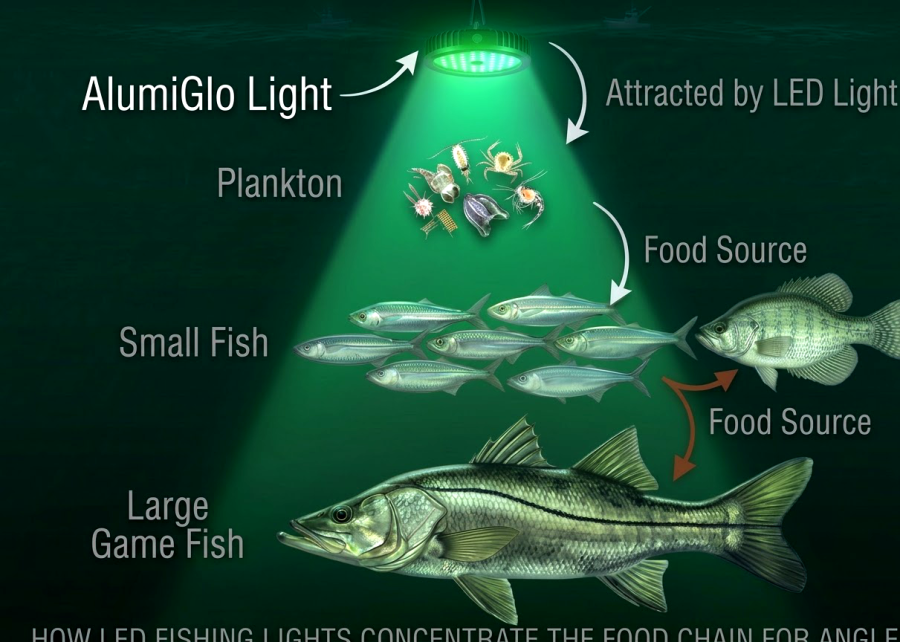
Submersible fishing lights are just as effective through the ice in winter as they are in open water during the summer. By creating a concentrated beam of green light under the ice pack, fixtures attract microscopic plankton, which quickly draws in baitfish and predatory game fish.
Recommended Fixture: Green SuperBrite 4800-C LED
Engineered specifically for harsh aquatic environments, our SuperBrite 4800 is an ideal solution for winter ice fishing:
-
High-Output Spectrum: Emits the optimal green wavelength to maximize light penetration through thick ice and murky water.
-
Rugged Construction: Built to withstand freezing temperatures and sub-surface pressure.
-
Efficient Power Draw: Delivers maximum brightness while preserving battery life during extended cold-weather trips.
Drop the SuperBrite 4800-C through your ice hole to turn your fishing spot into an active feeding zone.


How Underwater Fishing Lights Work in Winter
While submersible lights are a proven tool for summer night fishing, their effectiveness under the ice is one of hard-water fishing’s best-kept secrets. Lowering an underwater light through the ice initiates a natural food chain reaction:
-
Plankton Attraction: High-intensity light attracts microscopic plankton, the primary food source in any aquatic ecosystem.
-
Baitfish Response: Small forage fish move in to feed on the concentrated plankton.
-
Predator Instinct: Game fish naturally inspect any visible light source in dark winter waters, expecting an easy meal.
Understanding Winter Water Dynamics
Winter conditions require a slightly different approach than open-water summer fishing:
-
Increased Water Clarity: Cold, frozen lakes typically feature exceptional water clarity, allowing light to travel much farther than it does during summer algae blooms.
-
Fish Behavior: Cold-water game fish are generally more skittish and less aggressive.
Choosing the Right Light Intensity
Because winter waters are so clear, over-illuminating your fishing spot can actually spook wary game fish. Moderation is essential for success under the ice.
We recommend using our Green SuperBrite 4800-C LED Light. It delivers the precise brightness and green wavelength required to draw in plankton and game fish without overwhelming them or driving them away.
Ice Fishing with Submersible Lights: Setup & Placement Guide
Using submersible lights for ice fishing follows the same fundamental principles as summer night fishing. However, strategic positioning above and below the ice pack is key to maximizing your catch rate.
1. Location: Focus on Structure
Underwater lights attract fish, but they cannot create fish out of empty water. To be successful, always position your setup near established fish-holding structure:
-
Submerged brush piles and timber
-
Steep drop-offs and river channel edges
-
Rock piles and humps
Setting up near structure ensures that hungry game fish are already in the immediate area when your light activates the food chain.
2. Rigging & Hole Strategy: Drill Two Holes
To optimize your presentations and prevent lost fish, drill two separate holes spaced a few feet apart:
-
Hole 1 (Light Hole): Dedicate one hole solely to suspending your underwater light.
-
Hole 2 (Fishing Hole): Position your fishing line several feet away from the direct light beam.
Why This Works:
-
Prevents Tangles: Reeling a fighting fish up the same hole as your light cable frequently leads to tangled lines and lost tackle.
-
Targets the Strike Zone: Wary winter game fish often hover along the outer shadow line rather than directly inside the brightest beam. Fishing the perimeter yields higher strike rates.
3. Depth & Reflection: Keep It Shallow
A common mistake is dropping the light all the way to the lake bottom. For maximum coverage, suspend the light just below the bottom edge of the ice sheet.
The underside of the ice acts as a natural wide-angle reflector, pushing a broad, soft cone of light downward through the water column. The closer the light stays to the ice ceiling, the larger your illuminated zone will be.
Daytime Use Under Snow-Covered Ice
Submersible lights are not limited to night fishing. On lakes with heavy snow cover over the ice, sunlight cannot penetrate the water column. Operating your light during daytime hours in these dark underwater conditions is just as effective as fishing at midnight.
Equipment Recommendation
For cold-water conditions, we recommend our Green SuperBrite 4800-C LED Light. Its calibrated output provides the ideal spectrum to cut through dark water without overpowering skittish game fish.
Compact Deep Cycle Batteries


For those of you who need a smaller battery that will fit in a backpack, the compact batteries listed below will provide good light for a limited amount of time. Most compact batteries such as the 8-amp hour rechargeable battery from Cabela’s and many of the compact batteries from Amped Outdoors come with ‘Spade Clip” connections.
To find out how long a light will run on any given battery you take the Amp Hour rating of the battery and divide it by the amp draw of the light. For example, a 50-watt SuperBrite 4800-C draws about 4 amps per hour., so a 19-amp hr. battery would run the light for about 5 hrs. (19/4= 4.75 hrs)