
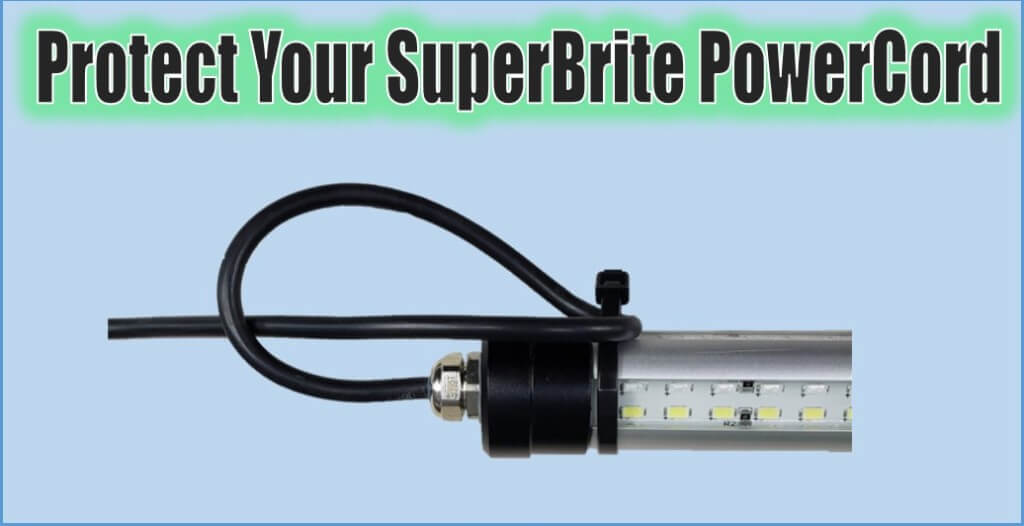
Technical Guide: Maximizing Power Cord Durability
Maintaining a completely watertight seal while preserving cable flexibility in high-flow underwater environments is one of the greatest engineering challenges for submersible lighting.
Understanding how water current and improper handling affect your equipment will help you extend the life of your light’s power cord.
Understanding Cord Wear & Mechanics
1. Strain-Relief Mechanics & Pinch Points
To ensure 100% watertight integrity, our AlumiGlo SuperBrite series utilizes a heavy-duty stainless steel strain-relief gland. This fitting prevents water intrusion and stops the cable from pulling free under load. However, because it securely anchors the cable, severe side-to-side bending creates a focal pinch point—similar to holding a wire with pliers and repeatedly flexing it until the copper conductors inside fatigue and break.
2. Water Current & Fixture Dynamics
Fast-moving tides and heavy currents exert continuous lateral force on submerged lights. Larger and heavier fixtures experience greater drag, causing the cord to rock back and forth continuously at the entry point if it is not properly rigged.
Primary Causes of Cord Damage (and How to Avoid Them)
Issue 1: Tying Off Too Close to the Fixture
-
The Cause: Securing the power cord directly to an anchor line or drop rope too close to the top of the light forces the cable to flex sharply back and forth in fast currents. Over time, this constant motion causes internal wire fatigue.
-
The Solution: Always leave a generous relief loop in the power cord above the fixture entry point before securing the main cable to your drop line. This transfers kinetic strain from the water current onto your drop rope rather than the strain-relief fitting.
Issue 2: Sharp Bends During Storage
-
The Cause: Pulling the power cord tight against the fixture body and wrapping it tightly for storage places continuous lateral pressure on the entry point, weakening both the outer jacket and the internal conductors.
-
The Solution: When coiling the cord for transport or storage, allow a relaxed curve at the strain-relief connection. Avoid sharp right angles or tight wraps directly against the top of the light.
Pro-Tips for Long-Term Operation
-
Rig for Strain Relief: Always support the weight of the light using a dedicated drop line or rope—never rely solely on the electrical cord to suspend or retrieve the fixture.
-
Inspect Regularly: Periodically check the entry point and stainless-steel gland for signs of wear, surface abrasions, or jacket stress.


Using the above strain-relief technique will help prevent damage to your fishing lights power-cord.