Battery Selection & Run-Time Calculations
Selecting the proper battery type is essential for maximizing the performance, runtime, and overall lifespan of your 12V lighting system.
Deep-Cycle vs. Starting Batteries
Always use a dedicated Deep-Cycle Battery to power your underwater and outdoor lights.
-
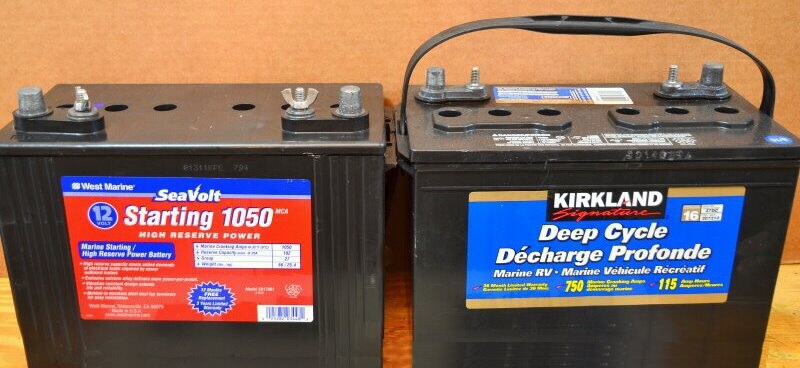
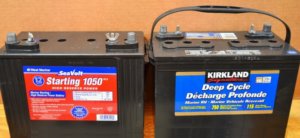
Starting Batteries: Engineered to deliver short, high-amperage bursts to start engines. They feature thin lead plates that degrade rapidly when continuously discharged, drastically reducing performance over time.
-
Deep-Cycle Batteries: Constructed with heavy-duty, thick internal plates designed specifically for continuous power delivery and repeated discharge/recharge cycles.
Key Identifier: A true deep-cycle battery displays an Amp-Hour (Ah) rating on its label. Note that Amp-Hours (energy storage capacity) and Cranking Amps (short-burst starting power) are two entirely different specifications.
How to Calculate Light Run Time
To estimate how long a fully charged battery will power your lights, divide the battery’s Amp-Hour (Ah) rating by the total amperage draw of your connected fixtures:
Run Time (Hours) = Battery Capacity (Ah) / Total Current Draw (Amps)
Example Calculation
A 30-Watt COB LED fixture draws approximately 2.5 Amps. Powered by an 8 Ah Battery:
Note: For optimal lead-acid battery health, avoid regularly discharging your battery past 50% of its rated capacity.
How Long Will Your Lights Run?
Understanding Battery Selection & Run Time
Continuous lighting demands a dedicated power source. To ensure maximum run time and long-term reliability, always power your system with high-capacity Deep Cycle batteries.
Unlike standard automotive (starting) batteries designed for short bursts of high energy, Deep Cycle batteries feature heavy-duty internal plates engineered for continuous discharge and repeated recharging cycles.
Key Selection Tip: Look for a true Amp Hour (Ah) rating on the battery label. Avoid relying on Marine Cranking Amps (MCA) or Cold Cranking Amps (CCA), which measure engine-starting power rather than sustained energy output.
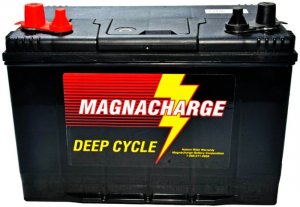
Full Size Deep Cycle Batteries
| Battery Type | Amp Hour Rating | Voltage |
|---|---|---|
| Group 27 | 100-115 Amp Hours | 12 Volts |
| Group 29 | 110-125 Amp Hours | 12 Volts |
Compact Deep Cycle Batteries
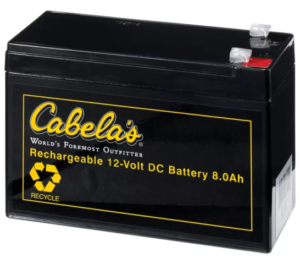
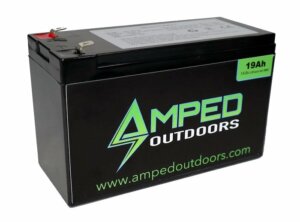
For those of you who need a smaller battery that will fit in a back pack, the compact batteries listed below will provide good light for a limited amount of time. Most compact batteries such as the 8-amp hour rechargeable battery from Cabela’s and many of the compact batteries from Amped Outdoors come with ‘Spade Clip” connections. We offer Spade Clip with S4 Connection on our Accessory Page.
To find out how long a light will run on any given battery you take the Amp Hour rating of the battery and divide it by the amp draw of the light. For example, a 30-watt COB draws about 2.5 amps., so a 8 amp hr. battery would run the light for about 3.2 hrs. (8/2.5= 3.2)
Starting Batteries vs Deep Cycle Batteries
Understanding Battery Selection & Power Requirements
Both Starting batteries and Deep Cycle batteries utilize lead-acid chemistry, but they are engineered for vastly different operational demands. Choosing the correct type ensures maximum performance, longevity, and reliable lighting.
Deep Cycle vs. Starting Batteries
-
Starting Batteries (Engine Cranking): Engineered with thin lead plates to maximize surface area, delivering high bursts of current for short periods to start an engine. Once started, the engine’s alternator maintains the charge. Starting batteries are not designed to be discharged below 80% capacity; deep discharging will cause premature battery failure.
-
Deep Cycle Batteries (Continuous Power): Built with significantly thicker internal plates designed to deliver a steady stream of power over extended periods. They can withstand hundreds of deep discharge and recharge cycles without degrading performance.
| Feature | Starting Battery | Deep Cycle Battery |
| Primary Function | High-surge engine cranking | Sustained, long-term illumination |
| Internal Plate Design | Thin (high surface area) | Thick (heavy-duty durability) |
| Discharge Tolerance | Shallow only (ruined by deep drain) | Repeated deep discharge cycles |
| Key Specification | Cold Cranking Amps (CCA) | Amp Hours (Ah) & Reserve Capacity (RC) |
Key Battery Metrics Explained
-
Cold Cranking Amps (CCA): The amperage a battery delivers for 30 seconds at 32°F (0°C). Critical for starting engines, but not an indicator of run time.
-
Reserve Capacity (RC): The number of minutes a battery can deliver a continuous 25-amp load while maintaining operational voltage (above 10.5V). Deep Cycle batteries typically provide 2 to 3 times the Reserve Capacity of a Starting battery.
Recommendation for Optimal Performance
-
For Equipment & Marine Engine Starting: Use a dedicated Marine Starting Battery.
-
For Continuous Lighting & Trolling Motors: Always use a Deep Cycle Battery.
Pro Tip: For maximum light output and run time, we recommend a Group 27 Deep Cycle battery (rated at 115 Ah or higher).
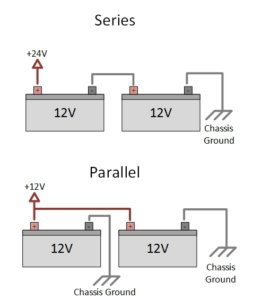
Linking your batteries – Parallel vs Series
Be sure you connect your batteries correctly!