Calculating Run Time: How Long Will Your Lights Last?
To maximize the performance and runtime of your LED lights, selecting the correct battery type is essential.
Deep-Cycle vs. Starting Batteries
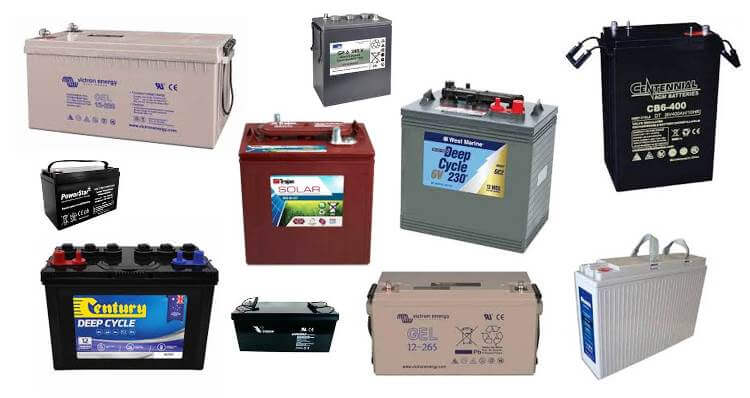
Always use a dedicated Deep-Cycle Battery to power your lighting systems. Standard starting batteries are engineered to deliver short, high-current bursts to start engines and feature thin internal lead plates that degrade rapidly when continuously discharged.
Deep-cycle batteries feature thicker internal plates designed specifically for repeated discharge and recharge cycles without losing capacity.
-
How to Identify a Deep-Cycle Battery: Look for an Amp-Hour (Ah) rating on the battery label. Note that Amp-Hours (energy capacity) and Cranking Amps (starting power) are entirely different specifications.
Estimating Battery Run Time Formula
To calculate how long your lights will operate on a fully charged battery, divide the battery’s total Amp-Hour rating by the total amp draw of your connected lights:
Example Calculation:
If you are running a 30-Watt LED Light that draws 2.5 Amps on an 8 Ah Battery:
Pro-Tip: For optimal battery longevity, avoid regularly discharging deep-cycle lead-acid batteries below 50% capacity. When sizing your battery system for full-night operation, select a capacity rating roughly double your minimum calculated power need.
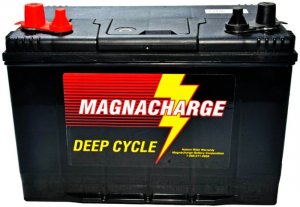
Common Full Size Deep Cycle Batteries
| Battery Type | Amp Hour Rating | Voltage |
|---|---|---|
| Group 27 | 100-115 Amp Hours | 12 Volts |
| Group 29 | 110-125 Amp Hours | 12 Volts |
Compact Deep Cycle Batteries
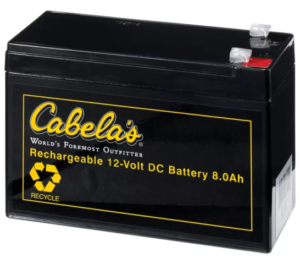
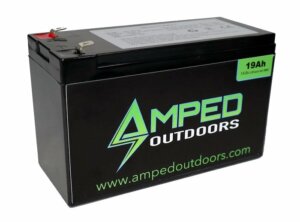
For those of you who need a smaller battery that will fit in a backpack, the compact batteries listed below will provide good light for a limited amount of time. Most compact batteries such as the 8-amp hour rechargeable battery from Cabela’s and many of the compact batteries from Amped Outdoors come with ‘Spade Clip” connections.
Starting Batteries vs Deep Cycle Batteries
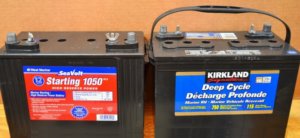
Deep-Cycle vs. Starting Batteries: Choosing the Right Power Source
While both starting and deep-cycle batteries rely on lead-acid chemistry, their internal construction is optimized for fundamentally different applications. Understanding these engineering differences ensures peak performance and longevity for your boat and lighting equipment.
Core Structural & Functional Differences
Starting Batteries: High Short-Term Power output
Engineered to deliver high-amperage bursts for short durations, starting batteries provide the immediate power necessary to turn over an engine. Once started, the alternator supplies power to the system and recharges the battery.
-
Internal Design: Manufactured with numerous thin lead plates to maximize surface area for rapid discharge.
-
Operational Limits: Designed to operate near full charge, typically utilizing less than 20% of their total capacity. Repeated deep discharges will rapidly degrade the thin plates and cause premature failure.
Deep-Cycle Batteries: Sustained Power Delivery
Engineered to deliver steady, continuous current over extended periods. Deep-cycle batteries handle continuous discharge and recharge cycles without structural degradation.
-
Internal Design: Constructed with heavy-duty, thick lead plates that retain charge for longer durations and resist wear from repeated cycling.
-
Operational Limits: Capable of enduring hundreds of complete discharge-and-recharge cycles while maintaining capacity and voltage stability.
Key Battery Ratings Explained
| Battery Specification | Primary Application | Description |
| CCA (Cold Cranking Amps) | Starting Batteries | Measures the max amperage delivered for 30 seconds at 32°F ($0^\circ\text{C}$). Critical for engine ignition. |
| RC (Reserve Capacity) | Deep-Cycle Batteries | Measures the total minutes a battery can supply a steady 25-amp load while maintaining voltage above 10.5V. |
Performance Summary: A deep-cycle battery typically provides 2 to 3 times the Reserve Capacity of a standard starting battery, though it delivers lower Cold Cranking Amps.
Powering Recommendations
-
Boat Engines: Use a dedicated Marine Starting Battery.
-
Lighting Systems & Trolling Motors: Use a high-capacity Deep-Cycle Battery.
System Requirement Notice
For optimal lighting performance and maximum brightness, we recommend a Group 27 Deep-Cycle Battery (rated at 115 Ah or higher). High-output LED systems require robust, consistent amperage to operate at peak output.
Operating 12VDC Lights on AC Power
If generator power or shore power is available at your dock, you can power 12VDC lights using a high-quality AC-to-DC converter. Always select a converter rated for higher amperage output than your system’s minimum requirement to ensure full brightness and prevent thermal stress on the converter.
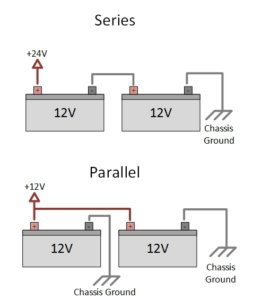
Linking your batteries – Parallel vs Series
Be sure you connect your batteries correctly!