Does Color Matter for Fishing Lights and Dock Lights?
While green underwater lighting has surged in popularity, anglers used white light for decades before green alternatives hit the market. Today, green, white, and blue are the three primary options for dock and fishing lights, leading many to ask: which color actually works best?
Although any light source will attract marine life when projected above or submerged below the surface, specific environmental conditions make certain colors far more effective. Baitfish react differently based on water clarity, depth, and ambient light. If bait isn’t gathering around your current setup, changing your light color can kickstart activity—much like swapping out a lure on a slow day.
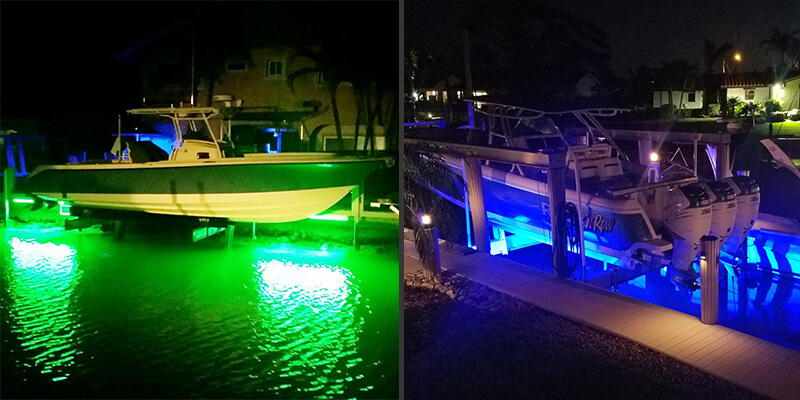
To give you maximum flexibility on the water, the AlumiGlo DockPro 4500-X3 dock light features a multi-color remote control, letting you instantly switch between Green, White, and Blue modes to adapt to changing conditions.

DockPro 4500-X3
When selecting lighting for boats, docks, or piers, green and white are the most effective choices for drawing in marine life. Because both project high brightness underwater, they attract baitfish and game fish from greater distances.
-
White Light (Maximum Coverage & Speed): Containing all wavelengths across the visible spectrum, white light produces higher overall lumen output than any other color. If fish are in the vicinity, white light will draw them in faster than alternative options. The trade-offs? White light creates higher ambient glare for human eyes and tends to attract more flying insects above the surface.
-
Green Light (The Industry Standard): Green light strikes an ideal balance. It cuts through cloudy or murky water exceptionally well, creates an attractive glow beneath the surface, and draws significantly fewer insects than white light—making it our most popular option among anglers and dock owners.
-
Blue Light (Aesthetics & Ambience): While blue light offers slightly less underwater penetration than green, it produces a soothing, high-end visual appeal. Blue is primarily chosen for cosmetic enhancements, dock accenting, hull lighting, and architectural highlighting.

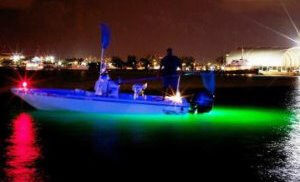

We are often asked how—and why—underwater lighting is so effective at attracting marine life. The mechanism is simple: light triggers a natural marine food chain that mirrors daily ecosystem behavior driven by sunlight, moonlight, or artificial light.
Applying light in or on top of the water draws in microscopic plankton. As plankton concentrates around the light source, small baitfish arrive to feed, which quickly draws larger game fish into the target zone.
Green Light vs. White Light: Which Performs Better?
While light selection is crucial for both fishing and shrimping, green and white remain the two industry-standard choices. Although green is currently the most popular, experimenting with both can turn a slow night into a successful outing.
Key Comparisons
| Feature | Green Light 🟢 | White Light ⚪ |
| Primary Function | Maximum fish attraction & depth penetration | Surface visibility, task lighting, utility |
| Bait Attraction | High volume of smaller baitfish (minnows, shrimp, shad) | Lower volume, but can attract larger baitfish |
| Murky/Stained Water | Superior (maintains color intensity 15–20 ft deep) | Poor (wavelengths scatter/absorb within 6–8 ft) |
| Above-Water Bugs | Attracts far fewer insects above the surface | Attracts swarms of bugs and mosquitoes |
| Human Utility | Poor for tying knots or navigating | Best for rig prep, cleanup, safety, & boat deck tasks |
Just as you would swap lure patterns based on conditions, switching light colors allows you to target specific marine activity.
To maximize your options on the water, our AlumiGlo SuperBrite X2 Dual-Color Fishing Light allows you to run Green light, White light, or BOTH simultaneously. For dedicated green-light enthusiasts, our high-output SuperBrite 4800-C Green LED Fishing Light has quickly become a premier choice for fishing, shrimping, and ice fishing.
How Colors Penetrate Water
| Color | Wavelength (nm) | Max Depth Penetration | Underwater Behavior & Best Uses |
| Red / Infrared | 620–750+ nm | Shallow (< 15–30 ft) | Absorbed first. Appears brown/black below 20 ft. Used primarily for low-visibility nocturnal observation near the surface without spooking marine life. |
| Orange / Yellow | 570–620 nm | Moderate (30–50 ft) | Absorbed relatively quickly. Yellow aids contrast in turbid surface waters but loses color vibrancy rapidly as depth increases. |
| Green | 495–570 nm | Deep (50–150+ ft in coastal/inland water) | Optimal for lakes, docks, & coastal waters. Green light matches the natural hue of plankton-rich waters, experiencing minimal scattering in algae-dense or murky conditions. |
| Blue / Cyan | 450–495 nm | Deepest (up to 300+ ft in open ocean) | Optimal for deep blue ocean water. Shortest usable wavelength that travels furthest in clear saltwater. Highly effective offshore for pelagic attraction and boat underwater accents. |
| UV / Purple | 380–450 nm | Shallow to Moderate | Quickly scattered by particulate matter. Mainly used to excite fluorescent lures, lines, or specific marine organisms rather than broad illumination. |
| White (Full-Spectrum) | 400–700 nm | Variable | Contains all wavelengths, but the red/orange components filter out within the first few feet, leaving a pale blue-green glow at depth. Best for high surface visibility and human color rendition. |
Pro Tip for Success
The secret to pulling game fish under your light is generating a dense concentration of bait. We recommend cycling through Green, White, and Dual-Color modes for 20 to 30 minutes each to observe which spectrum produces the highest bait density on any given night.