How and Why Lights Attract Fish
FISHING with artificial light has been around for many years. In the early days the most common method was to hang a lantern over the side of a boat. Some of the old timers thought the light attracted bugs (which they did), and in return the fish surrounded the boat in hopes of getting a meal. There are still those who believe the old theory of more bugs, more fish, but new technology has done much to disprove that theory.
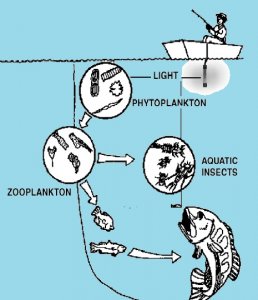
Projecting light in or on top of the water simply starts a natural food chain reaction by attracting a concentration of small, microscopic animals called plankton. Bait fish such as shad and minnows are drawn to the light to feed on the plankton; and larger game fish move in to feed on the bait fish. It’s not uncommon to see bait fish stacked in columns 15 feet thick under the lights, with game fish suspended directly below them. If you do not have baitfish congregating around the light after 30 minutes, move to a different area. Game fish follow the baitfish, so don’t waste time in area’s that do not hold baitfish.
The Basics
Rods, lures, fish locator’s and Underwater Lights all help increase your chances of catching your limits on a daily basis, but they are not magic. In order for lights to attract fish, there has to be fish to attract. If you have a dock that sits in 2 feet of water and you have never caught a fish in the area, chances are the lights will not be the magical solution to the problem. If the water is unsuitable to hold fish, not even lights will help lure fish into unhealthy water. Fish require good quality water, underwater structure to hide in and an open escape path into deeper water. If your dock is lacking any of these features, the number of fish you will attract to the light will be less.
With that said though, the use of artificial light WILL attract fish to your Boat or Dock if the boat or dock is located in water capable of holding fish and if you follow the below suggestions.
Fishing From a Boat
Anchoring Your Boat
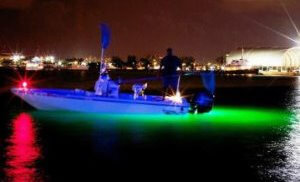
THE BOAT MUST BE ANCHORED IN ORDER FOR THE LIGHTS TO ATTRACT FISH! If you are drifting, the plankton and baitfish will never be able to gather around the light which will stop the food chain before it ever starts. ANCHOR YOUR BOAT WITH AT LEAST (1) ANCHOR AND PREFERABLE (2) ANCHORS SO IT CAN NOT PIVOT ON ONE ANCHOR LINE. The more stationery the better!
Set Up in an Area Where There Are Fish
Lures and Boats won’t help you a bit if you’re not fishing in an area that holds fish. If the water is to shallow, to deep or doesn’t have sufficient structure nothing will help you catch fish. This holds true when fishing from a Boat, Dock or thru the ice! Fish ALWAYS relate to water temperature and some kind of structure. This can be a drop off adjacent to a river channel, submerged brush or even a pile of rocks. If you aren’t fishing on or near some type of underwater structure your chances of attracting or catching fish are greatly reduced.
Remember, 10% of the water in any lake holds 100% of the fish. The rest of the lake is dead water….with or without a light. To fish, an old river channel running through the lake is like a highway to other areas of the lake and it provides cover and different depths of water for them to forage in. Ideally, a point or a bridge that has the old river channel running adjacent to it is hard to beat. Try and find a spot on the point where there is a good drop off. If the top depth is 10′ and drops to 50′ very fast, you would want to set up in 15′ to 25′ of water to start. If you don’t have any luck there, move deeper or shallower until you find the fish.
Attracting bait fish is a MUST! If the bait fish do not show up in the first 30 minutes after setting your lights, move to another spot. Just because they weren’t at one spot doesn’t mean they won’t be at another spot further down the lake. Water temperature and oxygen content are key factors in attracting large numbers of bait fish. If the water temperature is below 70 degrees or the oxygen content is poor, there will be less bait fish and game fish around the lights. If you boat or dock is sitting in good quality water which provides good structure, lights can attract baitfish by the thousands.
How Many Lights Do You Need When Fishing from a Boat?
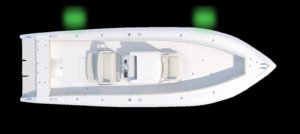
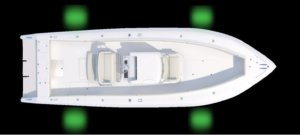
IF POSSIBLE, it’s always better to use (2) lights compared to (1) light in most circumstances. Using two lights spread 3′ to 4′ apart will give you a much wider radius of light and will allow more fisherman to fish in different zones of the light. However, if you have a smaller boat, one light will provide sufficient light.
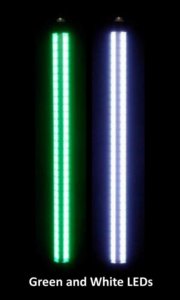
Using (2) lights will also let you experiment with different colors so you can see which color is attracting more baitfish on any given night. For example, starting with one white light and one green light will let you see which light is attracting the most baitfish at that particular time. Once you see which color is attracting the most fish, you can switch both lights to the same color. Our new SuperBrite X2 DUAL Color lights work great when experimenting.
Fishing From a Dock
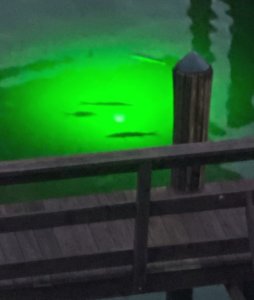
Lights are not magic; they are only a tool which helps attract and hold fish to your dock. If the water around the dock is not fish friendly, not even lights will improve the number of fish you have around your dock. All light does when applied in or on top of the water is start a basic food chain. The light attracts plankton, which is what baitfish feed on, and the baitfish attract larger game fish which feed on them. You need all elements of the food chain to be in place for it to complete itself, so the first thing you have to attract is baitfish. If you are not attracting baitfish, there is no way you will ever attract game fish. ALL of the below items are important when it comes to attracting and holding fish around your dock.
The Key Ingredients to attracting and holding fish:
- Food
- Depth of water
- Temperature of water
- Oxygen content of water
- Water flow (current)
- Underwater structure
- Deep water escape route
It is also important to make sure your light comes on at dusk and turns off at the same time every night. Typically having the light turn off in about 6 to 8 hours works better than leaving the light on from dusk to dawn because the fish know they have a limited amount of time to feed. Fish much like other animals and birds are creatures of habit. If they do not have a consistent food source every night, they will move to another location. Bird feeders work the same way. To attract birds to your back yard you must have Food, Water, a Feeder Mounted at the Proper Height, and there must be Enough Surrounding Cover for the birds to feel safe and be able to escape if need be. Eliminate any of those requirements and the birds will move to a neighboring feeder where conditions are better.
Above Water Lights
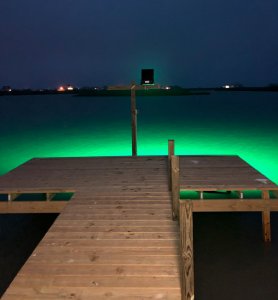
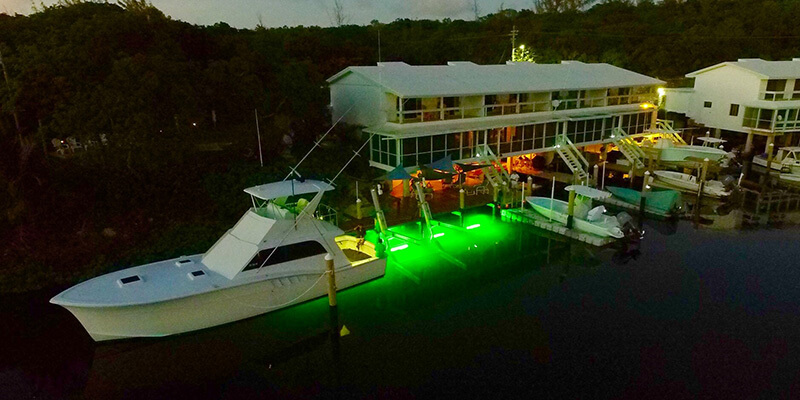
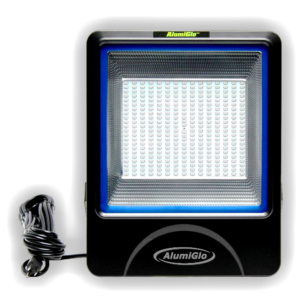
ALL of the electrical contractors and dock builders we sell lights too, now only install Above Water Lights such as our DockPro 4500-X3, DockPro 16,000, and DockPro 26,000. Above water lights require no maintenance and still attract just as many fish as the underwater lights. Above water lights not only attract fish to your dock, but they are also aesthetically pleasing at night. Above water lights can be used to not only illuminate the surrounding water but also above water structures and boats.

Underwater Lights
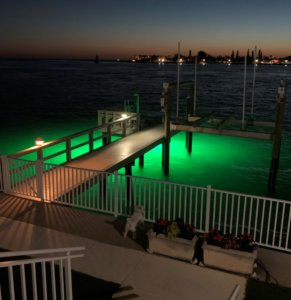
Underwater Dock Lights require regular maintenance, or they will soon be overtaken by algae, barnacles, clams, and other underwater marine life. Underwater lights which sit on the bottom and shine upward are popular because they allow you to see the fish more clearly in deeper water. However, underwater lights that sit on the bottom (regardless of manufacturer) are easily compromised by underwater marine life, acidic saltwater, hooks, and theft. So much so, we recently stopped selling all underwater lights that sit on the bottom and shine up.
Use a Photocell Timer
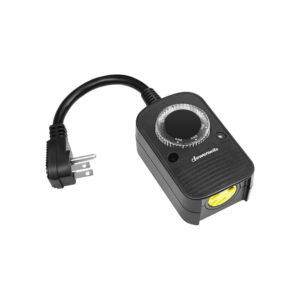
We always recommend using a Photocell Timer which turns the light on at dusk and then turns the light off at a predetermined time set by you. Fish become accustomed to knowing when the lights will be on so they can eat. If your light comes on at dusk and shuts off hours later every night, you will have more fish congregating around your dock at one time. If you leave the lights on from dusk to dawn, the fish will come and go at their leisure because they know they have all night to feed. Consistency is important so the fish know when feeding time is.